



Genomically Estimated Breeding Value Predictive Genetics and Chronic Wasting Disease in Elk
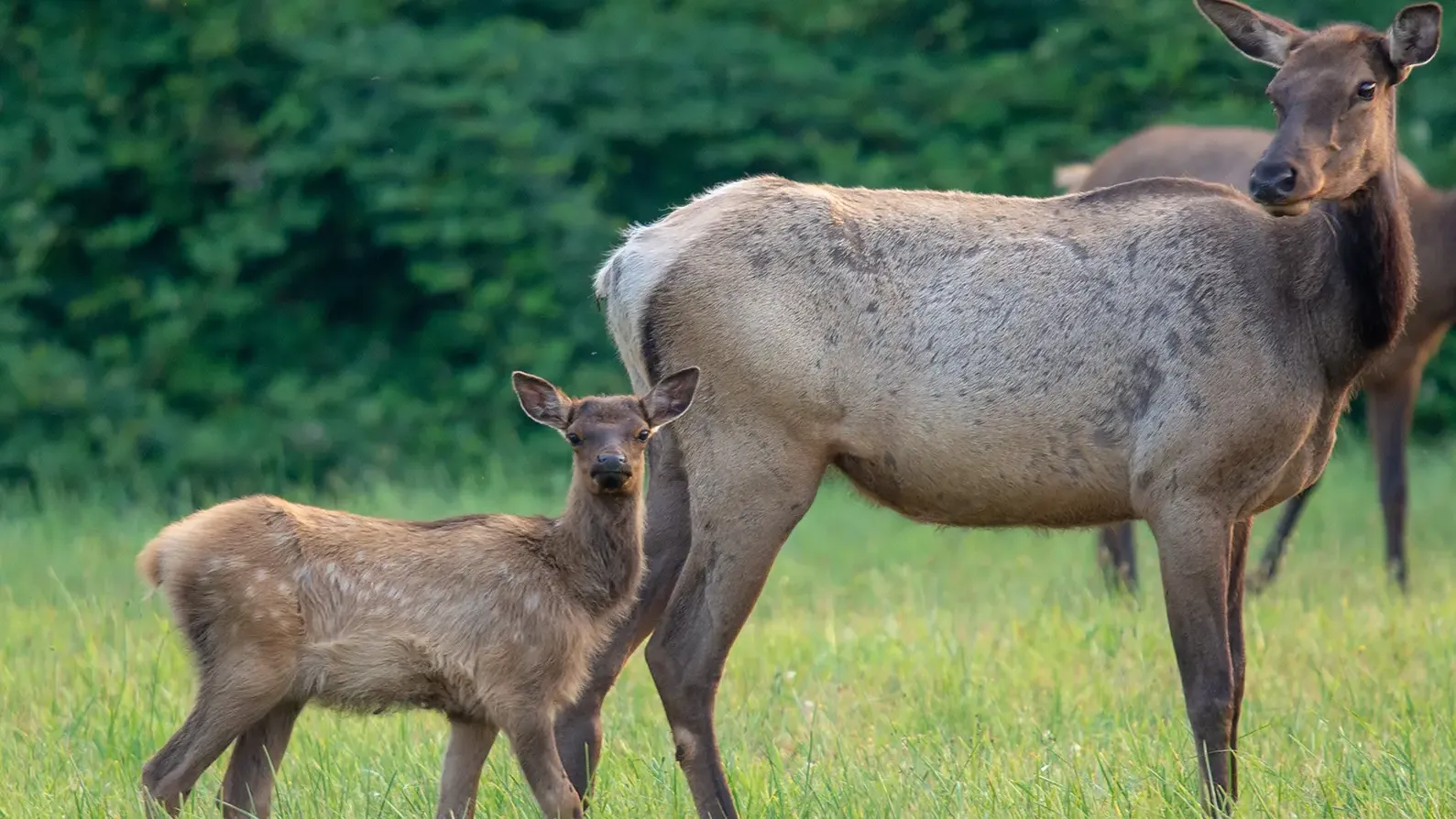
Genomically estimated breeding value (GEBV) predictive genetics can help elk producers better understand and manage herd susceptibility to chronic wasting disease (CWD). This page answers common questions about how GEBV scores are developed, what they mean, and how they can be used to support informed breeding decisions aimed at reducing CWD risk within elk herds.
For general information about CWD, visit Chronic Wasting Disease.
Frequently Asked Questions
A GEBV is a statistically generated number or score that estimates the total genetic potential of an animal with respect to a heritable trait. Traits are influenced and controlled by many different genetic regions, or loci, across the genome. In this situation, the trait is susceptibility of elk to CWD. The regions of interest are those that have a role in the CWD disease process, which is stated more simply as susceptibility. Seabury et al.1 found over 173,674 different regions of the elk genome that have a role in the CWD disease process. Each region provides a small contribution to the overall CWD disease process.
1 Accurate genomic predictions for chronic wasting disease in North American elk. 2026. Seabury et al.
The GEBV is produced by comparing and analyzing the effects of genetic regions from elk that have CWD to those that do not have CWD.
The score, which is presented as either a positive or negative number, reflects the potential for that elk to get CWD. The higher the number (on the positive side of zero) the greater the potential for that elk to become CWD positive if exposed to the disease. Elk should have a GEBV score of -0.06 or less to begin breeding a herd with reduced susceptibility to CWD. This is the starting point for herd improvement, not the end goal, which is having a herd of elk scoring as low as possible.
While some codons (the parts of DNA that code for a specific amino acid) in the prion gene, particularly codon 132 in elk, can strongly influence incubation period, the contribution of any codon to the total genetic merit (GEBV score) is rather low. Codon 132 contributes more to susceptibility than any other individual region elsewhere in the genome, but most of the overall susceptibility is due to the cumulative genetic contributions of these other regions. In other words, breeding for specific codon 132 genetics (ML or LL) alone is insufficient to significantly reduce herd susceptibility. That said, there is a role for codon 132 in reducing herd susceptibility, just not on its own.
The primary goal of predictive genetics using GEBV scores is to generate herds that are less susceptible to CWD, either avoiding the establishment of CWD after an exposure or limiting the spread within the herd if infected. Additionally, predictive genetics can be used in certain circumstances to clean up CWD-infected herds within or beyond a quarantine period.
The generation of herds with reduced susceptibility to CWD is only achievable when the steps below are diligently followed. Leaving poor-scoring, highly susceptible animals within a herd allows CWD to rapidly spread and contaminate the environment. Even good-scoring elk may not be able to withstand infection in highly contaminated environments or in herds with a high CWD prevalence.
Steps to using GEBV scores for herd improvement:
- Get GEBV scores that include codon 132 genetics on all animals within the herd, regardless of age. Good-scoring animals can be MM, ML, or LL. Do not cull a good-scoring animal simply because it is an MM unless there are sufficient animals in the herd with good scores and ML or LL genotypes.
- Identify all animals with scores above the minimum cutoff value of -0.06 (above means less negative and those that are closer to zero or that are positive numbers).
- Keep meticulous herd and breeding records that include GEBV scores and codon 132 data.
- Determine if the herd has a sufficient number of elk with scores below the cutoff to sustain a viable breeding population without breeding too tightly. Tight breeding to get desired scores is not recommended. Tight breeding will unmask negative recessive traits.
- Develop a culling plan to remove as many elk above the cutoff as possible. Some herds may not contain a sufficient number of elk below the cutoff to sustain the herd. In this situation, purchasing good-scoring animals or semen straws from good-scoring bulls is recommended to selectively breed with best-scoring cows on site. With careful breeding over several generations, the overall GEBV scores can be significantly improved and the herd susceptibility reduced over time.
- Good-scoring elk with ML and LL at codon 132 in the prion gene are ultimately the goal. However, good-scoring MM and ML elk can be bred with good-scoring mates to generate desirable offspring with ML or LL at codon 132. This allows for genetic improvement without tight breeding.
For More Information
If your situation is unusual or complex, contact us for help at cwd@usda.gov. Reaching out early can save time, money, and perhaps even your herd in the long run.