



Preventing and Managing Cormorant Damage
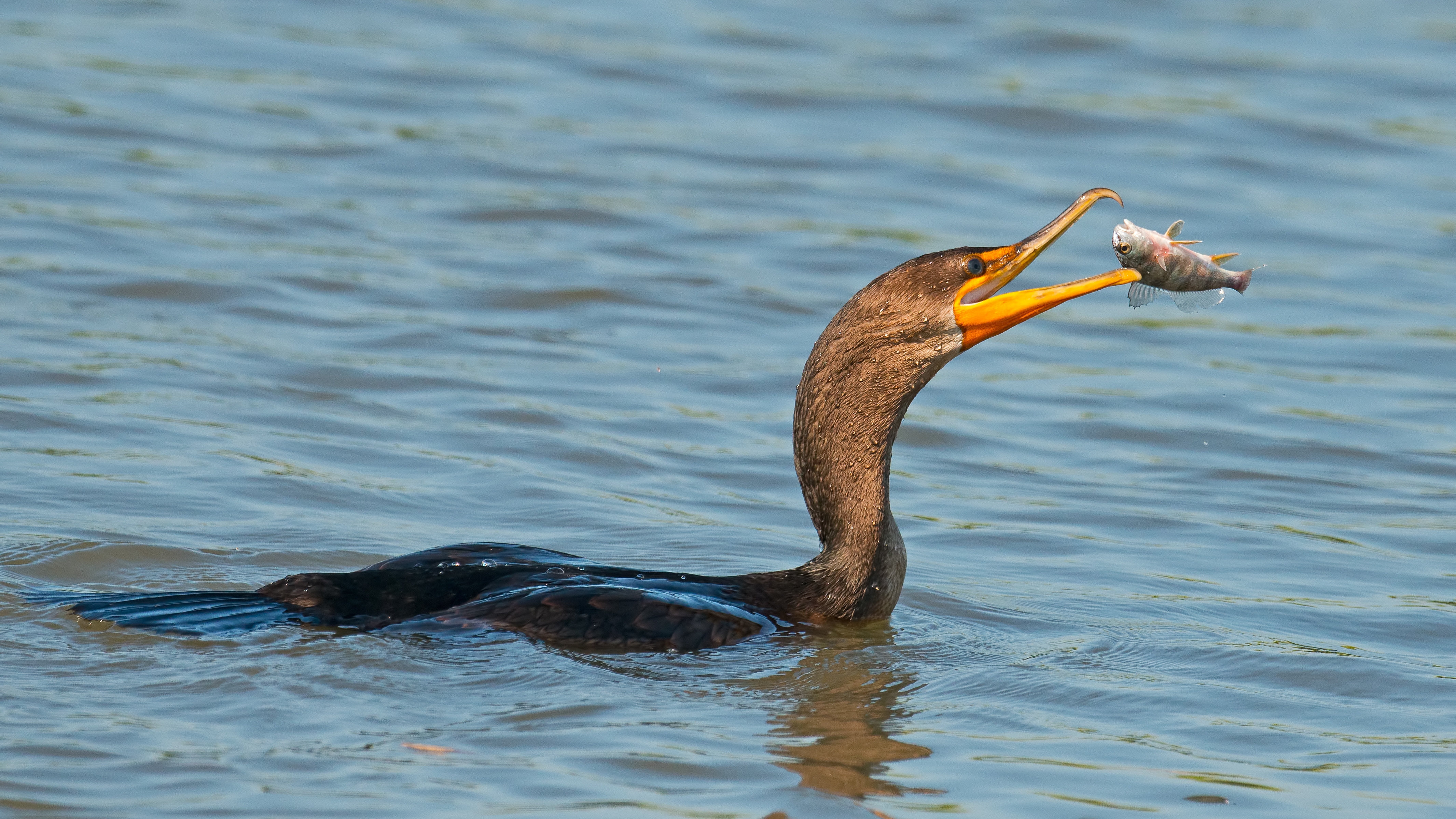
The double-crested cormorant (Nannopterum auritum; cormorant) is a fish-eating waterbird that can cause damage at aquaculture facilities and private ponds. Cormorants are found across the continental United States and along the southern coast of Alaska.
Cormorants feed almost exclusively on fish. They typically prey on small (less than 6 to 8 inches), bottom-dwelling, or schooling “forage” fish, especially those that are most abundant and easiest to catch. This includes fish such as alewife, gizzard shad, menhaden, yellow perch, sculpins, and sticklebacks.
Learn More About Cormorants
Conflicts
Cormorants often congregate and can have significant local impacts, particularly where high concentrations of fish occur, such as stocking release sites, private fishing ponds, aquaculture ponds, reservoirs, and fish spawning sites. In addition to direct predation, cormorants can injure fish, serve as potential disease vectors, destroy property, and damage vegetation.
Management Techniques
Managers should consult with APHIS Wildlife Services or a State wildlife agency before taking any action to manage cormorant conflicts. You can reach your State's Wildlife Services office by calling 1-866-4USDA-WS (1-866-487-3297).
Wildlife Services professionals recommend an integrated approach to discourage cormorants from congregating in areas when overabundant flocks cause problems. For long-term success, managers should use a combination of techniques to ensure birds don’t become accustomed to any single approach. Limited lethal control can help the effectiveness of harassment techniques.
When applicable, managers can remove nests or roost trees to encourage adult birds to leave the area. Tree removal is not effective when cormorants nest on the ground.
Hatchery-raised fish are particularly vulnerable when large numbers are released in a lake at once or when spawning behavior or natural movements, such as runs of salmon smolts, concentrate fish in small areas. Managers should release fish at night so they have time to disperse before cormorants begin feeding in the morning. In lakes, fish should be released in deep water rather than from shore to reduce predation. Managers can also stock fish early in the season before cormorants return from their wintering grounds. Fish are also vulnerable to cormorants when harvest methods congregate them in enclosed areas that cormorants can access.
Managers can alter aquaculture practices to reduce depredation by cormorants and other fish‑eating birds. For example, managers can use split‑pond production systems, where fish production occurs in a more contained area, making harassment of birds more effective and physical barriers more feasible.
Managers can use physical barriers such as netting or grid wire systems to prevent cormorants from preying on fish in hatcheries or aquaculture ponds. Nets are effective when their edges extend to the ground surrounding the pond to prevent cormorants from walking under the netting and into the water. While physical barriers can be effective, they can be impractical, and cost may be prohibitive for large ponds. In some instances, space may be limited for net supporting structures, and netting may interfere with machinery needed for daily operations.
Managers can deploy overhead-wire systems to make it difficult for cormorants to land on and take off from ponds. Although these systems are effective at preventing large flocks from landing, individual birds often learn to fly between the lines or land on levies and walk into the pond despite the wires.
Ropes with plastic floats, sometimes called bird balls, are a less expensive and less labor-intensive alternative to wire systems and can effectively make it difficult for birds to land and take off in ponds. Managers can string ropes with floats parallel to each other, about 50 to 55 feet apart. The success of both wire systems and floating ropes depends on the availability of alternative foraging areas nearby as birds that can find other food sources easily are more likely to be deterred.
Managers can discourage cormorants from using specific sites by applying harassment or scare tactics in an integrated and consistent fashion. Managers can haze birds at fish hatcheries and aquaculture facilities, as well as roosting and nesting sites (with appropriate permits) on larger bodies of water. Harassment is most effective when the birds are not nesting or before birds have become habituated to a location. Cormorants learn quickly, so frightening devices often do not deter the birds for long. For best results, managers use a variety of techniques and change the location and combination of devices frequently. In some cases, permitted supplemental lethal control may be needed to prevent habituation to nonlethal frightening methods.
Auditory Frightening Devices
Managers can use noise-producing devices, live ammunition, and pyrotechnics (such as shell crackers, screamers, whistling or exploding projectiles, bird bangers, and propane cannons) to disperse cormorants. Live ammunition is often the least expensive and most readily available form of a frightening device. Managers should be careful using live ammunition and noise-making devices to avoid injuring or killing cormorants and other protected species. These options are usually best for the short term and most effective when used in conjunction with other dispersing and exclusion methods.
Visual Frightening Devices
Managers can also use visual harassment techniques such as scarecrows, human effigies, and balloons. One can suspend Mylar tape on stakes near roosting and loafing sites to reduce cormorant use of those areas. In addition, managers can use boats to chase cormorants and successfully disperse roosts and flocks from ponds and larger bodies of water.
Managers can use hand-held lasers to disperse roosting cormorants. These are most effective in low light conditions (twilight, nighttime, overcast skies). In addition, lasers are silent and can be used to move cormorants with minimal disturbance to nontarget species. The regular presence of humans may frighten cormorants from smaller aquaculture or hatchery facilities, as well as from roosting sites and potential colonies. Managers can also encourage frequent human activity near valuable fish stocks to reduce depredation on fish.
Researchers are investigating the use of drones to disperse nesting cormorants from bridges and to harass birds on ponds.
Managers can use visual frightening devices and physical deterrents to prevent cormorants from loafing on oyster cages. Learn more.
Sometimes limited lethal control is necessary to prevent birds from acclimating to nonlethal methods.
The Migratory Bird Treaty Act of 1918 and State laws protect all native migratory bird species, including cormorants, in the United States. The U.S. Department of the Interior’s Fish and Wildlife Service can issue permits to remove otherwise protected birds if they are damaging agriculture, property, or natural resources or threatening human health and safety. Before a permit is issued, the requestor must demonstrate that nonlethal techniques were implemented and were not adequate in alleviating the damage. These “depredation” permits allow the permit holder to remove a limited number of birds from a specific area to enhance success of nonlethal techniques. Learn more about Federal depredation permits.
States may require State-specific permits for lethal control as well.
Shooting (permit required)
Shooting allows for relatively rapid reduction in cormorant numbers. Managers can protect specific sites by shooting open water areas and targeting night roosts.
One can use a 12-gauge shotgun with No. 4 or 6 nontoxic shot size to target cormorants. Shooting adult cormorants also harasses remaining birds and can be combined with pyrotechnics to enhance the effectiveness of nonlethal control options. Managers should remove carcasses and dispose of them using approved methods.
About Wildlife Services
Wildlife Services provides national leadership and expertise to help ranchers, farmers, wildlife managers, and others resolve conflicts between people and wildlife. Our programs and research protect U.S. agriculture and natural resources, property and infrastructure, and public health and safety. Wildlife Services biologists help individuals, local governments, businesses, and others manage cormorant damage to achieve a balance between the positive values and the conflicts the birds may present.
About Cormorants
There are five recognized subspecies populations of double-crested cormorants (Nannopterum auritum): Western, Central, Atlantic, Florida, and Caribbean. Neotropic cormorants (Nannopterum brasilianum) are similar to double-crested cormorants and can be found throughout most of South and Central America and in coastal areas from Alabama to California, occasionally ranging inland. They are less abundant than double-crested cormorants in the United States, but local concentrations can cause damage at individual facilities. There are four other species of cormorants found in the United States: the great, Brandt’s, pelagic, and red-faced cormorants. However, they are not typically associated with damage issues in the United States.
Double-crested cormorants nest primarily in the Great Lakes and Prairie Pothole regions of the United States and Canada and along the Atlantic and Pacific coasts, in colonies that can range from several pairs to over 10,000 pairs. Most return to the same location each year to breed. Young cormorants often return to the colony where they hatched or to nearby areas to breed. Typically, cormorants are sexually mature by their third year, but a small number may breed earlier.