



Preventing and Managing Pelican Damage
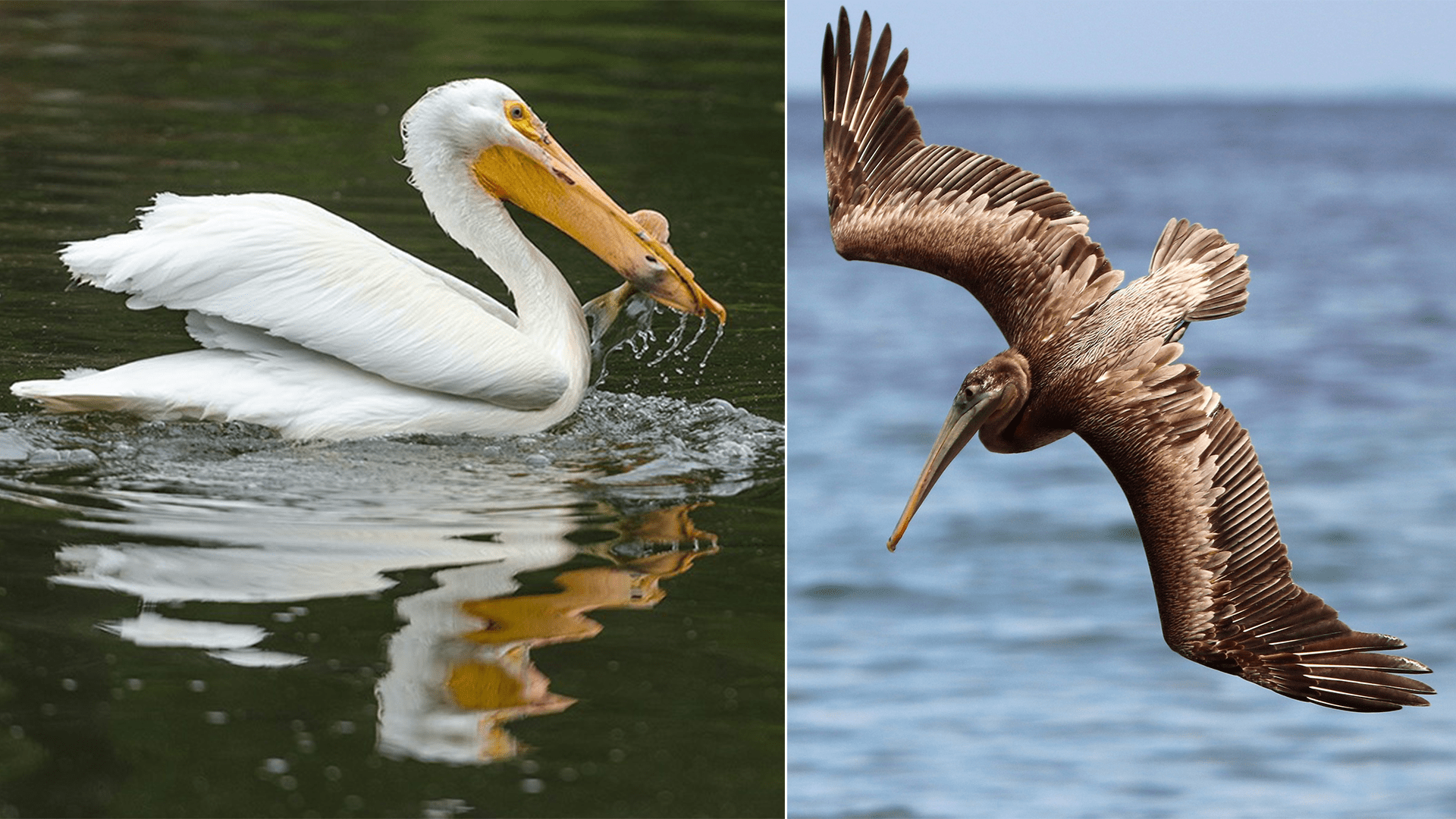
American white pelican (left) and brown pelican (right)
There are two species of pelicans in North America, the American white pelican (Pelecanus erythrorhynchos) and brown pelican (Pelecanus occidentalis).
American white pelicans breed in the western United States, the prairie States, and the western Canadian provinces. However, they have been expanding their breeding range eastward, particularly in the Great Lakes. Most winter along the coasts of Texas, Louisiana, Mississippi, and Alabama; in inland areas along large rivers, lakes, and reservoirs; and in the aquaculture-producing areas of Alabama, Arkansas, Louisiana, and Mississippi. Brown pelicans are found in marine environments along North America’s coasts. Winter movements vary, likely following food sources.
American white pelicans feed by scooping fish out of the water as they swim, whereas brown pelicans will usually feed by diving headfirst from the air into the water. Pelicans can eat relatively small fish if they are abundant as well as quite large fish up to 24 inches or larger, depending on the species.
Conflicts
American white pelicans more commonly cause conflicts at aquaculture facilities, as their feeding habits subject almost all fish in aquaculture ponds to predation. Brown pelicans can impact coastal facilities but are generally not associated with depredation problems further inland. Producers of shellfish such as oysters may have issues with brown pelicans defecating on grow-out cages, potentially creating problems with high bacterial counts.
Pelicans can occur in large flocks of 50 to several hundred birds and will often loaf on pond levees, in flooded fields, or on sandbars. Pelicans may fly far in a single day and may not feed near their loafing areas. They primarily feed during the day but can feed at night and may alter their feeding times to avoid harassment.
Pelicans can carry and spread the trematode Bolbophorus damnificus, a parasite that infects channel catfish. Pelicans are the final host for this trematode parasite that kills fingerlings and reduces growth and feed consumption in larger catfish, making them unsaleable.
Management Techniques
Managers should consult with APHIS Wildlife Services or a State wildlife agency before taking any action to manage pelican conflicts. You can reach your State’s Wildlife Services office by calling 1-866-4USDA-WS (1-866-487-3297).
Wildlife Services professionals recommend an integrated approach to discourage pelicans from congregating in areas where they cause problems. For long-term success, managers should use a combination of techniques to ensure birds don’t become accustomed to any single approach. Limited lethal control can help the effectiveness of harassment techniques.
Managers can encourage pelicans to abandon a loafing site if water is removed (for example, drain flooded fields). Other habitat modifications may include eliminating open wetland sites by planting perennial woody vegetation.
Managers can alter aquaculture practices to reduce depredation by pelicans and other fish-eating birds. For example, managers can use split-pond production systems where fish production occurs in a much smaller area of the pond, making harassment of birds more effective and the use of physical barriers feasible.
Hatchery-raised fish are particularly vulnerable when large numbers are released in a lake at once or during spawning behavior or natural movements, such as trout moving from lakes to rivers and streams to spawn. In lakes, one should release fish in deep water, rather than from shore, to reduce predation. Fish are also vulnerable when harvest methods congregate them in enclosed areas that pelicans can access.
Exclusion involves physically blocking a bird’s access to a site and is an important part of pelican damage management. Properly designed exclusion measures can prevent pelican predation on fish and the spread of disease.
The choice of a barrier system depends on the size of the facility and whether the barrier will interfere with other operations. Managers should also ensure that any barriers used do not pose hazards to nontarget birds, especially threatened and endangered species.
Choosing Effective Barrier Materials
Managers should choose barrier materials that are clearly visible to birds to reduce the risk of accidental entrapment or injury. Avoid using loosely hung, small-mesh netting, such as mist nets. Although often cost-prohibitive, near-total exclusion can eliminate up to 90 percent of pelican access to individual ponds.
Netting for Ponds and Raceways
In general, enclosing ponds and raceways to exclude all fish-eating birds requires 1- to 2-inch mesh netting secured to frames or supported by overhead wires. Gates and other openings must also be covered. In areas with harsh winters, make sure nets have an adequate framework or support cables to prevent ice or snow accumulation from tearing the netting.
Mesh Panel Use
Some hatchery operators use mesh panels placed on the raceway walls above the water to effectively exclude birds. Managers should secure small mesh wire or net less than 1 inch to wood or pipe frames to prevent birds from feeding through the panel. Panels should be designed to accommodate demand or automatic feeders and feed blowers that distribute food through mesh-covered raceways. Because panels may interfere with feeding, cleaning, or harvesting operations, they may be best suited for seasonal or temporary use.
Structural Needs
All exclusion structures must be strong enough to prevent the weight or activity of large birds from causing the net to sag within feeding distance of the water. They should also be built to allow the use of fish maintenance equipment and, when necessary, withstand wind and snow or ice accumulation. Non-rigid structures, such as suspended netting, may require lines, pulleys, and counterweights to raise and lower them during adverse conditions or maintenance.
Partial Exclusion Options
When full exclusion isn't practical, other barriers can still help limit pelican access. For example, nets suspended over catfish farm levees can prevent pelican depredation, though most levees are too narrow to accommodate both the net support structures and vehicle access. Plastic or wire grids over catfish ponds can deter pelican flocks from landing and taking off, but often do not exclude individual birds.
Frightening devices are used to modify bird behavior and discourage feeding, roosting, or gathering. Pelicans forage mainly during early morning and late afternoon and loaf during mid-day. If accessible, dispersing birds from loafing areas near affected facilities can effectively reduce depredation. On-farm pelican dispersal efforts are also effective; however, pelicans quickly adapt to standardized harassment schedules. American white pelicans usually forage during the day but may shift to nighttime foraging in areas where daytime harassment occurs. For example, pelicans have been seen leaving a loafing site to time their arrival and departure when harassment personnel are on lunch breaks. Varying both the timing and methods of harassment is usually most effective.
Auditory Frightening Devices
Managers can use noise-producing devices, live ammunition, and pyrotechnics—such as shell crackers, screamers, whistling or exploding projectiles, bird bangers, and propane cannons—to disperse pelicans. Live ammunition is often the least expensive and most readily available option. Managers should be careful using live ammunition and noise-making devices to avoid injuring or killing pelicans and other protected species. These tools are generally best for short-term use and most effective when combined with other dispersal and exclusion methods. When possible, dispersing pelicans from loafing areas such as flooded fields can also help move birds away from farms.
Visual Frightening Devices
Managers can also use visual harassment techniques such as scarecrows, human effigies, and balloons. Mylar tape can be suspended on stakes near feeding, roosting, or loafing sites to reduce pelican activity. Boats may also be used to chase and disperse flocks from ponds or larger bodies of water.
In south Louisiana, bright spotlights have been used successfully to disperse pelicans from catfish ponds at night. Hand-held lasers can also be effective, particularly in low-light conditions such as at dusk, at night, or under overcast skies. Lasers are silent and can move birds with minimal disturbance to nontarget species.
Regular human presence may deter pelicans from smaller aquaculture or hatchery facilities, as well as from roosting sites and potential colony locations. Encouraging frequent human activity near valuable fish stocks can help reduce depredation.
Sometimes limited lethal control is necessary to prevent birds from acclimating to nonlethal methods.
The Migratory Bird Treaty Act of 1918 and State laws protect all native migratory bird species, including American and brown pelicans, in the United States. The U.S. Department of the Interior’s Fish and Wildlife Service can issue permits to remove otherwise protected birds if they are damaging agriculture, property, or natural resources or threatening human health and safety. Before a permit is issued, the requestor must demonstrate that nonlethal techniques were implemented and were not adequate in alleviating the damage. These “depredation” permits allow the permit holder to remove a limited number of birds from a specific area to enhance success of nonlethal techniques. Learn more about Federal depredation permits.
States may require State-specific permits for lethal control as well.
Shooting (permit required)
Shooting allows for relatively quick reduction in pelican numbers. A 12-gauge or larger shotgun with T-shot or larger ammunition may be used. For individual birds, use a centerfire rifle of .22-caliber or larger (such as .223 or .22-250). Removing adult pelicans also serves as a deterrent to remaining birds and can be combined with pyrotechnics to enhance the effectiveness of nonlethal control methods. Managers should remove carcasses promptly and dispose of them using approved methods.
About Wildlife Services
Wildlife Services provides national leadership and expertise to help ranchers, farmers, wildlife managers, and others resolve conflicts between people and wildlife. Our programs and research protect U.S. agriculture and natural resources, property and infrastructure, and public health and safety. Wildlife Services biologists help individuals, local governments, businesses, and others manage cormorant damage to achieve a balance between the positive values and the conflicts the birds may present.